AI Developer Shift: From Code Writer to Quality Guardian
- Rocco
- August 27, 2026
- 04 min
- AI , Technology
At PavingWays, AI tools are woven into how we build and maintain apps for our clients every single day – from scaffolding boilerplate to drafting tests to reviewing pull requests. We’re a small team, so every hour AI can responsibly hand back to us multiplies what we can take on. But that only works if we keep learning how to use these tools safely: which parts of a codebase we let AI touch unsupervised, which parts always get a second, human look, and where the tooling itself needs guardrails before it’s trusted with production code. Getting that balance right is what lets a small development and app-maintenance shop like ours use the full power of AI-assisted development without trading away quality. Here are our thoughts on it.
The shift toward AI-generated code is no longer optional or avoidable – it’s the baseline. As AI coding tools mature, the conversation has to move beyond simple productivity gains and address a harder question: how do developer roles and delivery pipelines actually adapt once writing code stops being the bottleneck?
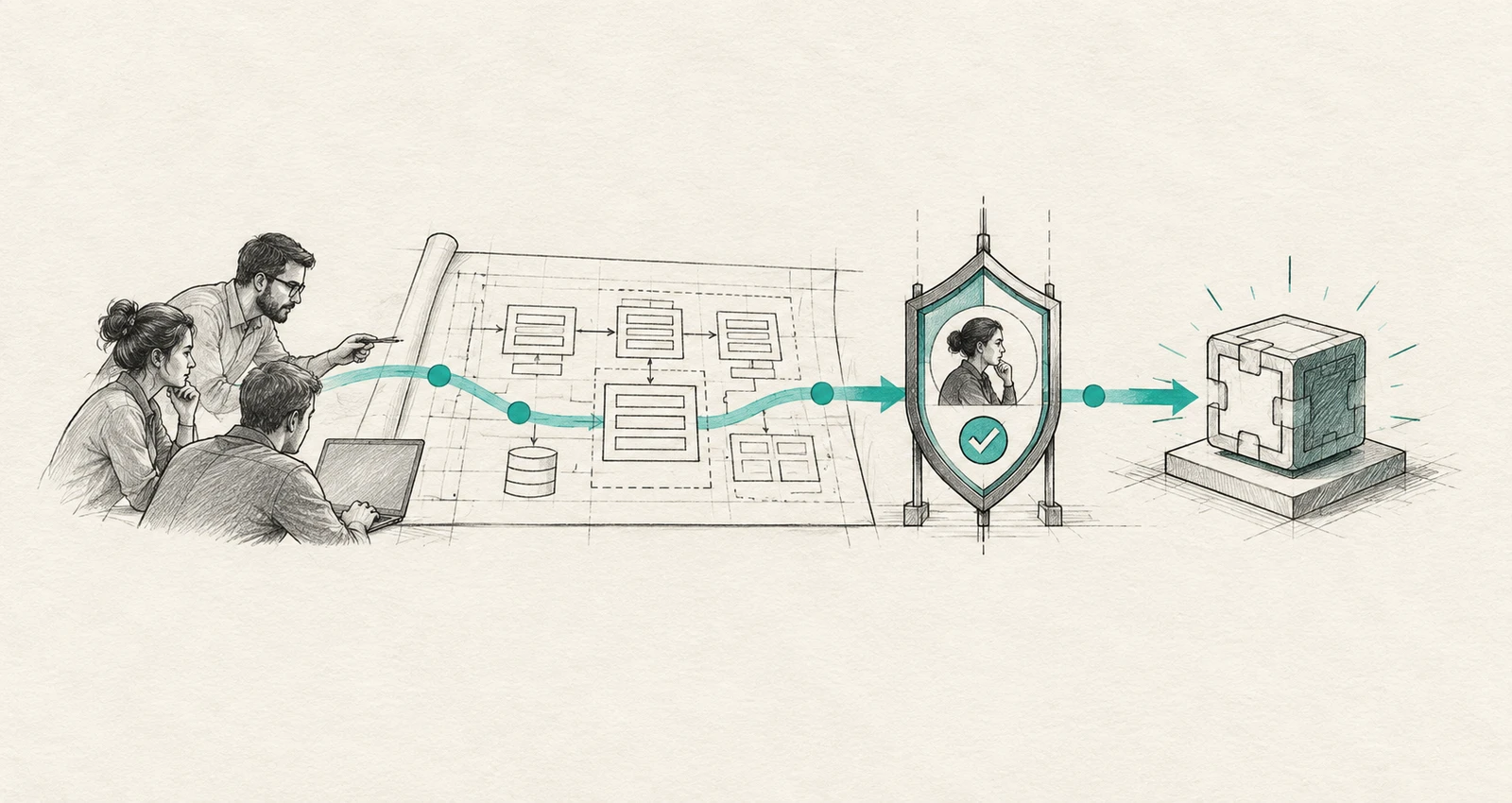
Some argue for “lights-out” automated factories. In practice, human judgment isn’t leaving software engineering – it’s shifting to the edges of the lifecycle: upfront intent and architectural design, and post-generation review and validation.
1. The upfront shift: intent, architecture, and user needs
When code generation becomes trivial, the hardest part of software engineering returns to its root challenge: knowing what to build.
- Focusing on the “what” over the “how”: developers move away from manual implementation toward precise requirements definition, domain modeling, and user-experience framing.
- Architectural blueprinting: AI can generate code rapidly, but it has no intrinsic long-term perspective. Developers still have to define strict architectural boundaries, system integrations, and performance constraints before a single line gets generated.
- Product ownership: spending less time wrestling with syntax and boilerplate leaves engineers with deeper ownership of the product – technical execution stays tied to real user value instead of drifting toward whatever’s easiest to implement.
2. The post-generation shift: senior-level review for everyone
AI doesn’t just write more code – it produces complex codebases instantly. That raises the bar for code review across the whole team.
- Every dev has to review like a senior: junior developers can no longer get by on syntax checks or minor refactoring suggestions. Reviews now have to evaluate code quality, security, maintainability, and architectural fit – every time.
- Managing velocity with stacked PRs: large, AI-generated code dumps aren’t reviewable. Stacked pull requests – breaking a big AI-generated change into small, interdependent PRs – let reviewers work through it piece by piece and merge cleanly, without a rebase mess at the end.
3. Scaling quality: living guidance, dynamic security, and automation
Keeping pace with AI-driven velocity without sacrificing quality means the review environment itself has to be explicitly configured to enforce standards.
- Living context (AGENT.md and skills): teams need structured context files and custom skills that tell the AI the rules – from structural patterns (“one class per file”) to UX guidelines (“action buttons keep a minimum edge padding”). Keeping those files current is a new, ongoing maintenance discipline in its own right, not a one-off setup step.
- AI-native UI testing: automated testing has to adapt too – AI agents that generate and run end-to-end suites (Playwright scripts derived straight from feature specs, for example) catch visual and functional regressions instantly instead of days later.
- Evolving security gates: static analysis tools like SonarQube stay critical, but the review agents also need to be fed moving security frameworks such as the OWASP Top 10, recalibrated as new threat vectors show up.
This is exactly the discipline we build into CI/CD and test-automation pipelines for clients – the tooling only holds up if someone keeps it honest as the codebase changes.
4. Redefining quality gates: why full automation is a trap
In a traditional pipeline, developers write code manually and lean on maximum automation to push it to production. Once code generation itself is automated, applying that same “lights-out” auto-deployment model on top just compounds the risk.
| Traditional workflow | AI-powered workflow | |
|---|---|---|
| Code creation | Manual, slow | AI-generated, near-instant |
| Review focus | Syntax, line-by-line implementation | Architecture, security, maintainability |
| Quality gate | Fully automated deployment to PROD | Automated checks and mandatory human review |
| Deployment | Continuous / unattended | Continuous, but gated on human sign-off |
The new rule: no AI-generated code reaches production without passing strict automated quality gates and getting explicit review and approval from a human developer.
Deliberately slowing the release gate down with human review and thorough QA is far cheaper than diagnosing and unwinding an unmaintainable, auto-deployed codebase after the fact.
A net positive for engineering culture
This shift isn’t a threat to software engineers – it’s an upgrade. Offloading repetitive implementation to AI while raising review standards gets teams faster delivery, higher quality, and broader test coverage. More importantly, developers move into a higher-leverage role: from line-by-line coders to product owners and system architects.
None of this works on autopilot, and it works best on a foundation of deep experience. We’ve been shipping and maintaining mobile apps for more than 20 years – long enough to have internalized what good architecture, a solid review, and a maintainable codebase actually look like, across several full platform-technology cycles. That’s exactly the foundation heavy AI usage needs: the pattern recognition to spot when a “quick” AI implementation is quietly cutting corners, and the judgment to know what deserves a second look versus what can reasonably be trusted. A team without that background inherits the same tools but not the same eye for when to slow down – and for developers earlier in their career, especially juniors, that gap matters more, not less, the faster AI lets them move.
If your team is figuring out where AI-assisted development fits into your own review and release process, let’s talk.