AI and the Role of Designers - SmashingConf
- Rocco
- September 8, 2026
- 04 min
- Conference , AI
I am attending SmashingConf Freiburg as an employee of Pax—thank you to Pax for the opportunity. I took notes on the talks and am sharing the thoughts they prompted here. This is a personal conference note, not a transcript and not a statement by Pax.
This is another post in a series of notes from SmashingConf Freiburg. The 2026 conference is taking place in Freiburg from September 7 to 10. The official schedule is here.
Ioana Teleanu’s talk, Who Designers Will Become with AI, began with a show of hands: a majority of people in the room expected the UX and product-design role to change dramatically in the next five years. The reason was familiar: AI makes execution cheap.
Her argument was not that designers are about to disappear. It was that roles have never been fixed identities. When a large part of producing an artifact becomes quicker or cheaper, the work around that artifact changes—and the value of the person doing it changes with it.
Cheap execution does not make decisions cheap
Ioana pointed to Anthropic as an example. She said that the company still hires developers while using AI to develop 90% of its code. Whether the work is design or development, the point is the same: automating a great deal of execution does not remove the need for people who can decide what the work should achieve and whether the result deserves to be used.
In her framing, designers were never primarily there to create output. Their core work is making decisions. With AI, that decision-making role becomes more explicit: designers design how the AI decides.
That means:
- asking the right questions before work starts;
- making the decisions that affect the product; and
- creating the guardrails within which AI can produce useful work.
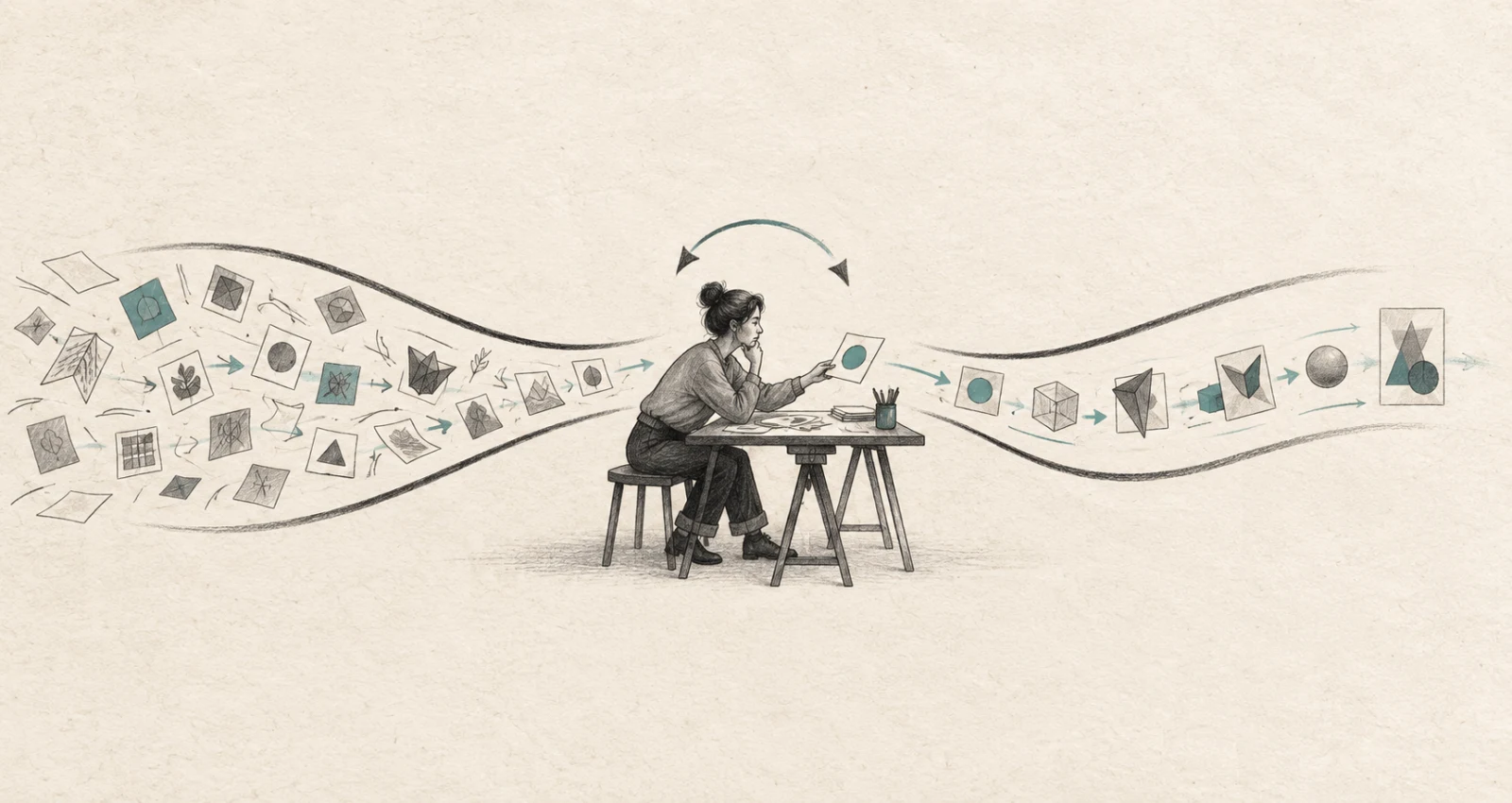
The designer becomes a director of AI behaviour and output: someone who curates possibilities, supplies context and accepts responsibility for the final decision. AI can generate many plausible answers. It cannot tell us which one supports the user, the product or the organisation’s actual goal.
The design loop gets tighter
As the work changes, the process has to change too. Ioana contrasted an older, more linear sequence with a faster loop:
| Earlier workflow | Emerging workflow |
|---|---|
| Learn → prototype → validate → build | Learn → build → learn → build → … |
This does not mean validation is gone. It means that a build can now be a quick way to learn, and learning can happen much closer to production of the artifact. The cycle becomes faster because a person no longer has to do every repetitive execution step by hand.
Ioana asked designers how they work now and found a common sequence of activities:
- Reason: plan, talk through the problem and get feedback from AI.
- Contextualize: tell the AI the relevant rules and set its boundaries.
- Produce: let it create an artifact.
- Judge: make the essential human decision about whether it is right.
- Refine: improve the result and make the next decision.
The position of Figma is revealing here. In many of these workflows, designs in Figma are made during refinement, not as a complete artifact at the very beginning. They record and sharpen a decision that has been tested in a faster loop; they are not necessarily the gate that allows the loop to start.
There will not be one new job description
Workflows are already fragmenting. Individual designers, teams and agencies are finding different ways to distribute thinking, prompting, prototyping, production and review. That makes a tidy replacement job description unlikely. The role is becoming less clear-cut, not more.
Ioana’s practical advice was reassuringly human:
- use the time freed by repetitive work for analog thinking and prototyping; and
- ship only what you can defend out loud.
The second point is an excellent test. If we cannot explain why an AI-produced design is appropriate, what assumptions it makes and which trade-offs we chose, we have not really made the decision. We have merely accepted an output.
My take: this is a role shift for all of us
This strongly connects to our earlier post, AI Developer Shift: From Code Writer to Quality Guardian. The developer role changes when AI handles more implementation: architecture, context, review and quality gates become more valuable. Ioana makes the parallel case for UX and product design: framing, boundaries, judgment and responsibility become more valuable there too.
I think the pattern reaches beyond designers and developers. As AI absorbs more repetitive tasks, the distinctly human parts of work gain weight: identifying the real problem, deciding what matters, recognising when an answer is wrong and taking responsibility for what goes out into the world. I see that as a good thing.
It also explains why AI literacy matters. The question moves from “What can we do with this?” to “Are we building the right thing?” Problem-solving moves from how to what. The biggest version of the job may be the one in which people have more room to think, prototype and decide—provided they use that room rather than simply producing more output.
For us, that is part of a good app-development partnership: using faster tools without outsourcing product judgment. If you are working through what AI changes in your own product team, get in touch.